



 +91-6280082254

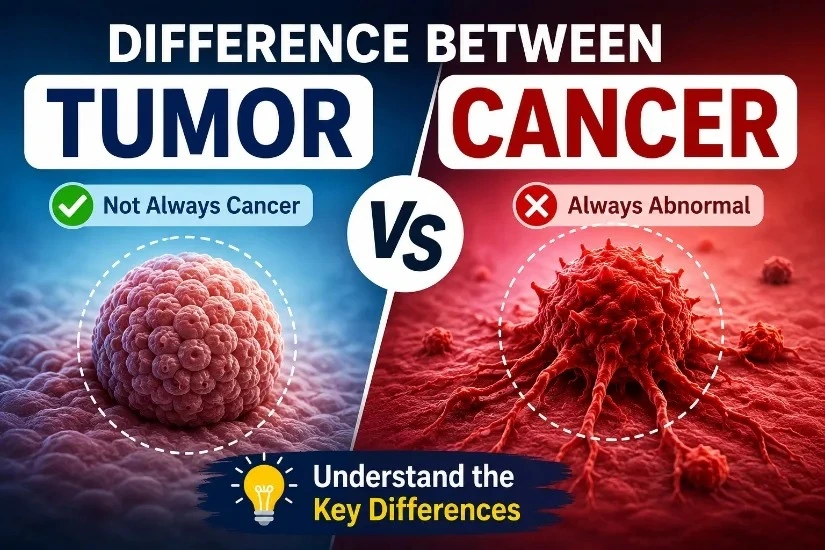
The words “tumor” and “cancer” are often used interchangeably, but they do not mean exactly the same thing. If a scan or medical examination reveals a tumor, it does not automatically mean that a person has cancer. A tumor is an abnormal mass of tissue that develops when cells grow or divide more than they should, or when abnormal cells fail to die as they normally would. Tumors can be benign (non-cancerous) or malignant (cancerous).
Cancer, on the other hand, is a disease in which abnormal cells grow uncontrollably and may invade nearby tissues or spread to distant parts of the body. Many cancers form solid tumors, but some cancers—such as many leukemias—generally do not form a solid tumor.
This distinction is important because finding a lump, mass, nodule, or tumor on an ultrasound, CT scan, MRI, mammogram, or other investigation does not by itself establish a cancer diagnosis. Doctors consider the location, size, appearance, symptoms, and other clinical findings, and a biopsy may be required to determine whether abnormal cells are cancerous.
In this guide, we will explain the difference between tumor and cancer, what benign and malignant mean, whether every tumor is cancerous, how doctors determine whether a tumor is cancer, how tumors are diagnosed and treated, and what patients should know after a tumor is discovered.
What Is a Tumor?
A tumor is an abnormal mass of tissue that develops when cells grow and divide more than they should or fail to die when they normally would.
Tumors are also called neoplasms. They may occur in almost any part of the body and can vary greatly in size, shape, growth rate, and behavior.
Importantly, a tumor can be:
- Benign, meaning it is not cancer
- Malignant, meaning it is cancerous
Therefore, the word tumor does not automatically mean cancer.
A tumor may be discovered because a person notices a lump, experiences symptoms, or undergoes an imaging test for another reason. Some tumors are easy to feel, while others are located deep inside the body and may only be detected through imaging.
What Is Cancer?
Cancer is a disease in which abnormal cells grow uncontrollably and may invade surrounding tissues or spread to other parts of the body.
Normally, cells divide in a controlled way. Old or damaged cells die, and new cells replace them. Cancer develops when this normal control system becomes disrupted.
Cancer cells can:
- Continue dividing when they should stop
- Avoid normal cell-death mechanisms
- Invade surrounding tissues
- Enter blood or lymphatic vessels
- Travel to distant organs
- Establish new cancerous growths in other locations
Cancerous tumors are also called malignant tumors.
However, not every cancer produces a solid mass. Blood cancers such as leukemia generally do not form a typical solid tumor, although they are still cancers.
Tumor vs Cancer: What Is the Difference?
The simplest way to understand the distinction is:
A tumor is an abnormal mass of cells or tissue. Cancer is a disease involving abnormal cells that grow uncontrollably and can invade tissues or spread. A tumor may be benign or malignant.
| Feature | Benign Tumor | Malignant Tumor / Cancer |
|---|---|---|
| Cancerous? | No | Yes |
| Growth | Often slower, but varies | May grow at different rates |
| Local invasion | Usually does not invade nearby tissues | Can invade surrounding tissues |
| Spread to distant organs | Does not metastasize | Can metastasize |
| Effect on nearby structures | May cause pressure or obstruction | May invade or damage nearby structures |
| Recurrence | Can occur in some cases | Can occur after treatment |
| Treatment | Observation, medication, or surgery depending on the tumor | May include surgery, chemotherapy, radiation, targeted therapy, immunotherapy, or combinations |
The behavior of a tumor—not simply its presence or size—is an important part of determining whether it is benign or malignant.
Is Every Tumor Cancer?
No. Not every tumor is cancer.
This is one of the most important facts for patients to understand.
Tumors are broadly classified into two categories:
1. Benign tumors
These are non-cancerous tumors. They generally remain localized and do not invade nearby tissues or spread to distant organs.
2. Malignant tumors
These are cancerous tumors. They can invade nearby tissues and may spread through the bloodstream or lymphatic system to other parts of the body.
Therefore, hearing that an imaging report has identified a “tumor” or “mass” does not automatically mean that the person has cancer.
Further evaluation is often needed to determine exactly what the abnormality represents.
What Is a Benign Tumor?
A benign tumor is a non-cancerous growth.
Benign tumors usually remain confined to the area where they developed and do not metastasize to distant organs. However, “benign” does not always mean “unimportant.”
A benign tumor can sometimes become medically significant because of:
- Its size
- Its location
- Pressure on nearby organs
- Pressure on nerves or blood vessels
- Hormone production
- Bleeding
- Obstruction
- Pain or other symptoms
For example, a benign tumor in the brain may cause significant problems because even a non-cancerous mass can put pressure on important brain structures.
Examples of benign tumors
Examples include:
- Lipoma
- Fibroma
- Adenoma
- Hemangioma
- Meningioma
The behavior and treatment of each type can be different, so a doctor may recommend observation, further testing, or treatment depending on the individual situation.
What Is a Malignant Tumor?
A malignant tumor is cancer.
Malignant tumors contain cancer cells that can grow abnormally and invade surrounding tissues. Some can also spread to distant organs through the bloodstream or lymphatic system.
The seriousness of a malignant tumor depends on several factors, including:
- The type of cancer
- Where it started
- Its size
- Its grade
- Whether lymph nodes are involved
- Whether it has spread to distant organs
- The molecular characteristics of the cancer
- The person's overall health
This is why simply knowing that a tumor is “malignant” is not enough to understand the complete diagnosis. Doctors usually need additional information to determine the cancer's stage and the most appropriate treatment.
Benign vs Malignant Tumor: What Are the Main Differences?
Benign tumors
Benign tumors generally:
- Are not cancer
- Remain localized
- Do not metastasize
- May grow slowly
- May still become large
- Can cause symptoms by pressing on nearby structures
Malignant tumors
Malignant tumors:
- Are cancerous
- Can invade surrounding tissues
- May spread to distant organs
- Can cause progressive symptoms
- May recur after treatment
- Usually require a cancer-specific treatment plan
However, growth rate alone cannot reliably determine whether a tumor is benign or malignant. A slowly growing tumor can be cancerous, and some benign tumors can grow relatively quickly.
How Does Cancer Differ From a Tumor?
The terms overlap, but they are not interchangeable.
Think of the relationship this way:
Tumor → may be benign or malignant
Malignant tumor → cancer
But:
Cancer → does not always form a solid tumor
This last point is particularly important.
Many cancers of solid organs form masses or tumors. Examples include:
- Breast cancer
- Lung cancer
- Colon cancer
- Rectal cancer
- Stomach cancer
- Liver cancer
- Pancreatic cancer
- Kidney cancer
- Ovarian cancer
However, blood cancers such as leukemia generally do not present as a single solid tumor.
So saying “all cancer is a tumor” would not be medically accurate.
Can a Benign Tumor Become Cancerous?
This depends entirely on the type of tumor.
Some benign lesions have no meaningful tendency to become cancer, while certain abnormal or precancerous lesions can have a risk of progressing to cancer.
It is therefore not correct to assume that every benign tumor will eventually become cancer.
For some specific lesions—such as certain types of colorectal polyps—doctors may recommend removal because particular types can develop into cancer over time.
The risk depends on:
- The exact pathology
- The organ involved
- The type of cells
- The size of the lesion
- Cellular abnormalities
- Genetic or molecular features
- Other individual risk factors
This is why a doctor may recommend surveillance or removal even when an abnormal growth is not currently cancerous.
Does the Size of a Tumor Mean It Is Cancer?
No. Tumor size alone cannot determine whether a tumor is cancerous.
A large tumor can be benign, while a relatively small tumor can be malignant.
For example, some benign tumors can grow to a substantial size while remaining localized. Conversely, some cancers may be detected when they are relatively small.
Tumor size is important in many cancer staging systems, but it is interpreted together with other factors rather than used alone to determine whether a mass is cancerous.
Can a Small Tumor Be Cancerous?
Yes.
A small tumor can be malignant.
The size of a mass does not tell doctors everything about its biological behavior. A small cancer may already have characteristics that require treatment, while a much larger benign tumor may not be cancer.
This is why suspicious masses should be evaluated based on their overall clinical and pathological characteristics.
Can a Large Tumor Be Benign?
Yes.
Some benign tumors can become quite large.
A large size may cause symptoms because of pressure on surrounding organs, nerves, blood vessels, or other structures. However, size by itself does not prove malignancy.
Can a Tumor Spread to Other Parts of the Body?
A benign tumor generally does not metastasize.
A malignant tumor, however, may spread to other parts of the body.
This process is called metastasis.
Cancer cells can break away from the primary tumor and travel through the bloodstream or lymphatic system. If they establish themselves in another organ and begin growing there, a metastatic tumor can develop.
For example, if breast cancer spreads to the liver, the cancer in the liver is still metastatic breast cancer, not liver cancer.
The cancer cells retain characteristics of the original cancer.
What Does Metastasis Mean?
Metastasis means the spread of cancer from the location where it first developed to another part of the body.
The process can involve several steps:
- Cancer cells grow at the primary site.
- Some cells invade surrounding tissue.
- Cancer cells enter blood vessels or lymphatic vessels.
- They travel to another part of the body.
- They leave the blood or lymphatic system.
- They establish growth in the new location.
Not every cancer cell that travels successfully establishes a new tumor. However, when metastatic growth develops, it represents cancer that has spread from its original site.
What Causes Tumors?
Tumors develop because normal control over cell growth and division becomes disrupted.
The exact causes vary according to the tumor type.
Possible contributing factors can include:
- Genetic changes
- Inherited genetic conditions
- Environmental exposures
- Hormonal influences
- Chronic inflammation
- Previous radiation exposure
- Certain infections
- Lifestyle-related risk factors
However, the cause of an individual tumor is not always identifiable.
Importantly, finding a tumor does not automatically tell you why it developed.
What Causes Cancer?
Cancer develops through genetic changes that disrupt normal cell growth and survival.
These changes can occur because of:
- Random errors during cell division
- Inherited genetic changes
- Tobacco exposure
- Certain infections
- Ultraviolet radiation
- Other environmental exposures
- Some occupational exposures
- Certain lifestyle and metabolic factors
Cancer is not one single disease. There are many different cancers, and each cancer can have different causes, risk factors, biological characteristics, and treatment approaches.
What Are the Symptoms of a Tumor?
Symptoms depend heavily on the tumor's location, size, and type.
A tumor may cause:
- A lump or swelling
- Pain or discomfort
- Bleeding
- Changes in bowel or bladder habits
- Difficulty swallowing
- Persistent cough
- Headache
- Neurological symptoms
- Abdominal swelling
- Changes in menstruation
- Unexplained pressure or fullness
However, some tumors produce no symptoms at all and are discovered incidentally during imaging performed for another reason.
The presence of a symptom does not necessarily mean cancer. Many symptoms associated with cancer can also be caused by benign conditions or other medical problems.
What Symptoms May Suggest Cancer?
Cancer symptoms vary according to the type and location of cancer.
Possible warning signs include:
- Unexplained weight loss
- Persistent fatigue
- A new or enlarging lump
- Unexplained bleeding
- Persistent cough
- Difficulty swallowing
- Persistent abdominal pain
- Changes in bowel habits
- Changes in urination
- Persistent or unexplained pain
- Non-healing sores
- Persistent fever or night sweats in some situations
These symptoms are not specific to cancer. Many benign conditions can produce similar symptoms.
However, symptoms that persist, worsen, or cannot be explained should be assessed by a healthcare professional.
How Are Tumors Diagnosed?
The evaluation depends on where the tumor is located and what doctors suspect.
Possible investigations include:
Medical history
The doctor may ask about:
- Symptoms
- Duration of symptoms
- Family history
- Previous illnesses
- Previous cancer
- Medications
- Smoking or alcohol exposure
- Other relevant risk factors
Physical examination
A doctor may examine a lump, swelling, lymph nodes, abdomen, breast, skin, or another relevant body area.
Imaging
Depending on the situation, doctors may use:
- Ultrasound
- X-ray
- CT scan
- MRI
- Mammography
- PET/CT
- Endoscopy
Imaging can provide important information about the location, size, shape, and characteristics of a mass. However, imaging does not always establish whether a mass is definitively cancerous.
What Is the Role of a Biopsy?
A biopsy involves removing a sample of tissue or cells so that it can be examined by a pathologist.
In many situations, a biopsy is the most definitive way to determine whether abnormal tissue contains cancer cells.
Depending on the location and type of suspected lesion, a biopsy may be performed using:
- A fine needle
- A core needle
- An endoscope
- An incisional surgical procedure
- An excisional surgical procedure
The appropriate method depends on the location, size, suspected diagnosis, and clinical circumstances.
The tissue is examined under a microscope, and additional laboratory tests may be performed to identify the exact type and characteristics of the cells.
Can an Imaging Scan Confirm Cancer?
Imaging can be extremely useful, but an imaging scan alone does not always confirm cancer.
A scan may show that a lesion looks:
- Benign
- Suspicious
- Indeterminate
- Potentially malignant
The next step depends on the specific situation.
Sometimes a lesion has classic benign characteristics and can simply be monitored. In other cases, further imaging, biopsy, or removal may be recommended.
The decision should be individualized rather than based solely on the word “tumor” appearing in an imaging report.
How Is Cancer Diagnosed?
Cancer diagnosis usually involves multiple pieces of information.
Depending on the suspected cancer, doctors may use:
- Medical history
- Physical examination
- Blood tests
- Imaging
- Endoscopy
- Biopsy
- Pathology
- Molecular or genetic testing when appropriate
In most cases, a biopsy is required to establish a definite cancer diagnosis, although the exact diagnostic approach varies by cancer type.
Once cancer is confirmed, additional tests may be required to determine its stage.
What Is Cancer Staging?
Cancer staging describes how extensive the cancer is.
Depending on the cancer type, staging may consider:
- Primary tumor size
- Local invasion
- Lymph node involvement
- Distant metastasis
- Other pathological or molecular characteristics
Imaging tests, examinations, biopsies, and laboratory investigations may all contribute to staging.
Staging is important because it helps doctors determine the most appropriate treatment strategy.
How Are Benign Tumors Treated?
Not every benign tumor requires immediate treatment.
Depending on its type, size, location, and symptoms, a benign tumor may be:
Observed
Some benign tumors can be monitored with periodic examination or imaging.
Surgically removed
Removal may be considered when a tumor:
- Causes symptoms
- Continues to grow
- Presses on important structures
- Causes bleeding or obstruction
- Has uncertain characteristics
- Is difficult to distinguish from a malignant lesion
Treated in another way
Some tumors may have treatment options other than surgery depending on their type and location.
The decision should be based on the specific diagnosis rather than the word “tumor” alone.
How Is Cancer Treated?
Cancer treatment depends on the cancer type, stage, molecular characteristics, location, and the patient's overall health.
Treatment may include:
- Surgery
- Chemotherapy
- Radiation therapy
- Immunotherapy
- Targeted therapy
- Hormone therapy
- Other systemic treatments
- Combinations of these approaches
For some cancers, surgery is an important part of treatment because removing the primary tumor and, when appropriate, involved lymph nodes can help achieve local control.
For other cancers, systemic treatment may be the primary treatment or may be given before or after surgery.
There is no single treatment that applies to every cancer.
Tumor vs Cancer: Common Myths
Myth 1: Every tumor is cancer.
Fact: No. Tumors can be benign or malignant.
Myth 2: If a tumor is large, it must be cancer.
Fact: Size alone cannot determine whether a tumor is cancerous. Some benign tumors can become very large.
Myth 3: If a tumor is small, it cannot be cancer.
Fact: Small tumors can be malignant.
Myth 4: A benign tumor can never cause serious problems.
Fact: Some benign tumors can cause significant problems because of their location, size, or pressure on important structures.
Myth 5: Cancer always forms a tumor.
Fact: Many cancers form solid tumors, but some blood cancers, such as leukemia, generally do not form a solid mass.
Myth 6: A scan can always tell whether a tumor is cancer.
Fact: Imaging can identify suspicious characteristics, but a definitive diagnosis may require tissue examination.
Myth 7: Malignant and benign mean the same thing as “large” and “small.”
Fact: Benign and malignant describe biological behavior, not simply size.
When Should You See a Doctor About a Tumor or Lump?
You should seek medical evaluation if you notice:
- A new lump
- A lump that is growing
- Persistent swelling
- Unexplained bleeding
- A persistent change in bowel or bladder habits
- Unexplained weight loss
- Persistent pain
- Difficulty swallowing
- Persistent cough
- A change in an existing lump
- Any imaging report showing a suspicious mass
This does not mean that the finding is cancer.
The purpose of evaluation is to determine what the abnormality actually represents.
The National Cancer Institute notes that many symptoms that can occur with cancer are more commonly caused by benign tumors or other conditions. Persistent symptoms should nevertheless be assessed rather than ignored.
What Should You Do If Your Scan Says “Tumor”?
First, don't assume the worst.
A report mentioning a “tumor,” “mass,” “lesion,” or “nodule” does not automatically mean cancer.
Instead:
- Discuss the report with your treating doctor.
- Understand exactly where the lesion is located.
- Ask what the imaging characteristics suggest.
- Find out whether additional imaging is needed.
- Ask whether biopsy is recommended.
- If cancer is diagnosed, ask about the type and stage.
- Discuss treatment options with the appropriate specialist.
Avoid making a diagnosis based solely on an imaging report or internet search.
Is a Biopsy Always Needed?
Not necessarily.
The need for a biopsy depends on the specific lesion and clinical circumstances.
Some lesions have imaging characteristics that are sufficiently typical of a benign condition that doctors may recommend observation rather than immediate biopsy.
In other cases, tissue diagnosis is important before treatment.
The decision depends on factors such as:
- Location
- Size
- Imaging appearance
- Symptoms
- Medical history
- Previous cancer
- Risk factors
- Whether the result would change treatment
When a biopsy is recommended, the procedure and method are selected according to the location and suspected diagnosis.
Does a Biopsy Make Cancer Spread?
This is a common concern among patients.
The possibility of cancer cells spreading along a biopsy path—sometimes called tumor seeding—exists in medicine but is extremely rare. The benefits of obtaining an accurate diagnosis generally outweigh this very small risk when a biopsy is appropriately indicated.
Patients should discuss the recommended biopsy method and its benefits and risks with their treating doctor.
Tumor vs Cancer: Why the Difference Matters
Understanding the terminology can help patients interpret medical reports without unnecessary panic.
If a report says:
“Mass”
It means an area of tissue that appears different from surrounding tissue. It does not automatically mean cancer.
“Tumor”
It generally refers to an abnormal growth or mass. It may be benign or malignant.
“Benign tumor”
This means a non-cancerous tumor.
“Malignant tumor”
This means a cancerous tumor.
“Metastasis”
This means cancer has spread from its original location to another part of the body.
Knowing these terms can make conversations with doctors easier and help patients understand what further testing may be needed.
Key Takeaways
- A tumor is not automatically cancer.
- Tumors can be benign or malignant.
- A benign tumor is non-cancerous and generally does not spread to distant organs.
- A malignant tumor is cancerous and can invade nearby tissues and potentially metastasize.
- Tumor size alone does not determine whether a tumor is cancer.
- A small tumor can be malignant, while a large tumor can be benign.
- Not every cancer forms a solid tumor; many blood cancers generally do not.
- Imaging can identify suspicious masses, but a biopsy may be needed to establish a definitive diagnosis.
- If you discover a new or growing lump, persistent symptoms, or a suspicious mass on imaging, seek appropriate medical evaluation rather than assuming that it is either benign or cancerous.
Conclusion
The difference between a tumor and cancer is important but often misunderstood.
A tumor is an abnormal mass of tissue, and it can be either benign or malignant. A malignant tumor is cancer, while a benign tumor is not. Cancer can invade nearby tissues and, in some cases, spread to distant organs through the blood or lymphatic system. At the same time, some cancers do not form solid tumors at all.
If a scan or examination identifies a tumor, there is no reason to assume immediately that it is cancer. The next step is proper medical evaluation. Depending on the situation, doctors may recommend observation, additional imaging, laboratory tests, or a biopsy.
The most important message is simple: the word “tumor” is a description, not automatically a cancer diagnosis. Understanding whether a growth is benign or malignant requires evaluation of its clinical, imaging, and, when appropriate, pathological characteristics.
Frequently Asked Questions (FAQs)
Medical Disclaimer
This article is intended for general educational purposes and should not be used as a substitute for professional medical advice, diagnosis, or treatment. A lump, mass, tumor, or abnormal imaging finding should be evaluated by a qualified healthcare professional. The appropriate diagnostic and treatment approach varies according to the individual patient and the specific condition.
References
- National Cancer Institute (NCI) - https://www.cancer.gov/about-cancer/understanding/what-is-cancer
- National Cancer Institute (NCI) - https://www.cancer.gov/about-cancer/understanding/what-is-cancer
- National Cancer Institute (NCI) - https://www.cancer.gov/about-cancer/diagnosis-staging
- American Cancer Society - https://www.cancer.org/cancer/understanding-cancer/what-is-cancer/neoplasms-and-tumors.html
- American Cancer Society - https://www.cancer.org/cancer/diagnosis-staging/tests/biopsy-and-cytology-tests.html
- American Cancer Society - https://www.cancer.org/cancer/diagnosis-staging/staging.html

Dr. Lovedeep Singh Chauhan
Dr. Lovedeep Singh Chauhan is a Consultant in Surgical Oncology at Max Super Speciality Hospital, Mohali. He has received advanced training in cancer surgery from leading national institutes (Tata Memorial Hospital, Mumbai) and has extensive academic, clinical, and research experience across multiple subspecialties of surgical oncology.


